


Selling a home is one of the most significant financial decisions most people make. One of the largest costs in this process is the average real estate commission. This fee usually covers both the listing agent, who represents the seller, and the buyer’s agent. In 2025, the national benchmark for this fee hovers around 5.5%–6% of the home’s sale price.
Understanding the average real estate commission is vital for both buyers and sellers. It affects your net proceeds, your budgeting, and even your choice of agent. This guide will examine commission trends in 2025, including state-by-state variations, city-level insights, and factors driving these numbers. You will also learn tips to negotiate a fair commission and make the most of your real estate transaction.
Why the Average Real Estate Commission Matters
The average real estate commission is more than just a number. It plays a critical role in your home sale. Here’s why:
- Impact on proceeds: On a $400,000 home, a 5.5% commission amounts to $22,000. That’s a significant chunk of your earnings.
- Negotiation leverage: Knowing the typical commission in your area allows you to negotiate more effectively.
- Market insight: Higher or lower commission rates can indicate how competitive a market is or the number of active agents.
- Budget planning: Estimating the commission helps you forecast your net proceeds and closing costs accurately.
With these points in mind, let’s explore national trends before diving into state and city specifics.
National Trends for 2025
Across the United States in 2025, the average real estate commission sits around 5.57%. This percentage includes both the listing agent and the buyer’s agent combined.
Historically, commissions have ranged from 4% to 6%, with variations depending on home price, property type, and the local market. The rise of discount brokerages and technology platforms has created more options for sellers. As a result, the national average has seen slight declines in recent years.
While the average gives a useful benchmark, your commission can differ depending on negotiation, market conditions, and the services provided by your agent.
Factors That Affect the Average Real Estate Commission
Several factors influence commission rates:
- Market competition: A high number of agents competing for listings often leads to lower rates.
- Home price: Expensive homes sometimes carry lower percentages because the dollar amount is high.
- Agent services: Agents offering staging, professional photography, and marketing campaigns may charge more.
- Property type and location: Rural homes, luxury properties, or unique homes may require higher commissions.
- Regulatory environment: Changes in rules regarding buyer agent fees and transparency have increased negotiation opportunities.
Understanding these factors allows sellers and buyers to make informed decisions and ensures commissions align with services provided.
State-by-State Average Real Estate Commission in 2025
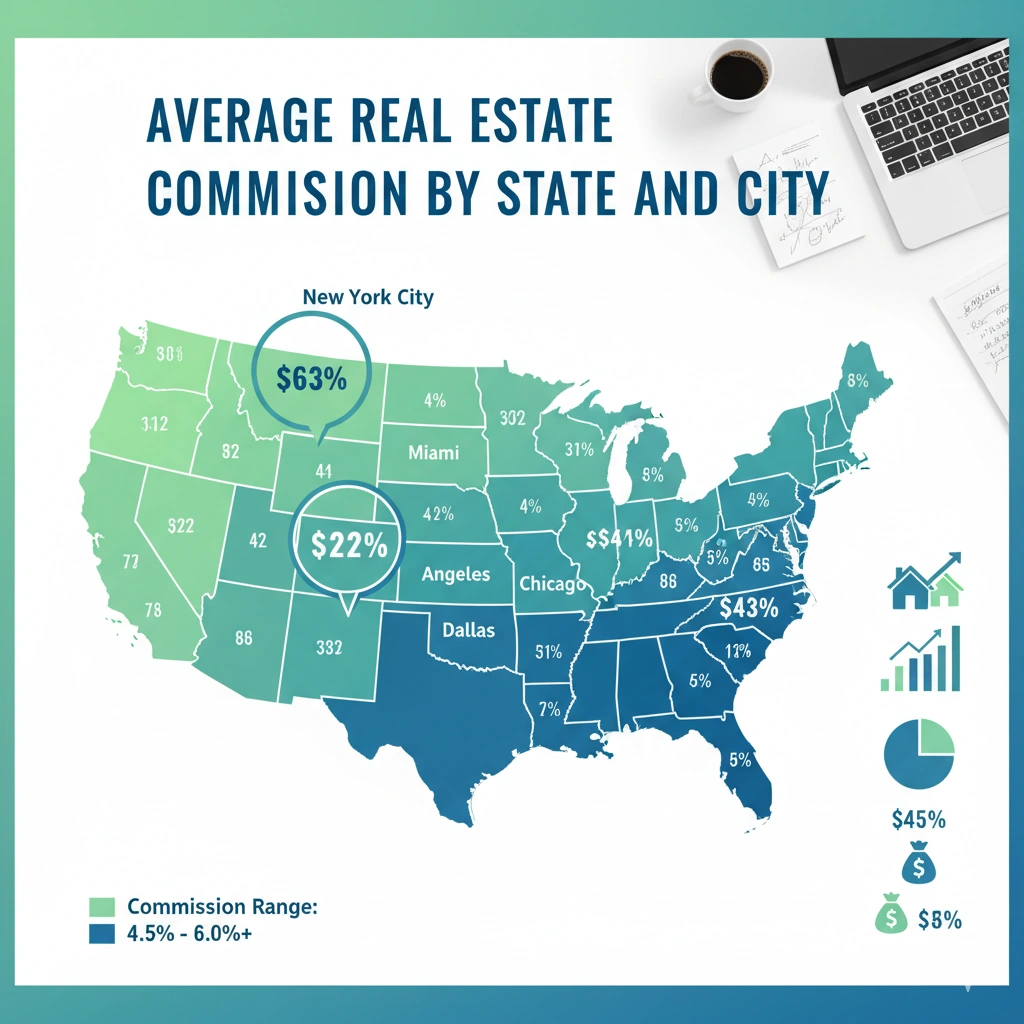
Commission rates vary from state to state. Here’s a detailed look at the average real estate commission across all 50 states:
| State | Average Real Estate Commission 2025 |
| Alabama | 5.65% |
| Alaska | 5.50% |
| Arizona | 5.45% |
| Arkansas | 5.60% |
| California | 5.55% |
| Colorado | 5.50% |
| Connecticut | 5.40% |
| Delaware | 5.48% |
| Florida | 5.05% |
| Georgia | 5.67% |
| Hawaii | 5.60% |
| Idaho | 5.52% |
| Illinois | 5.48% |
| Indiana | 5.55% |
| Iowa | 5.60% |
| Kansas | 5.58% |
| Kentucky | 5.62% |
| Louisiana | 5.57% |
| Maine | 5.50% |
| Maryland | 5.45% |
| Massachusetts | 5.39% |
| Michigan | 5.86% |
| Minnesota | 5.55% |
| Mississippi | 5.60% |
| Missouri | 5.57% |
| Montana | 5.50% |
| Nebraska | 5.55% |
| Nevada | 5.48% |
| New Hampshire | 5.50% |
| New Jersey | 5.55% |
| New Mexico | 5.52% |
| New York | 5.76% |
| North Carolina | 5.55% |
| North Dakota | 5.53% |
| Ohio | 5.58% |
| Oklahoma | 5.60% |
| Oregon | 5.50% |
| Pennsylvania | 5.52% |
| Rhode Island | 5.48% |
| South Carolina | 5.57% |
| South Dakota | 5.50% |
| Tennessee | 5.60% |
| Texas | 5.50% |
| Utah | 5.52% |
| Vermont | 5.48% |
| Virginia | 5.50% |
| Washington | 5.50% |
| West Virginia | 5.55% |
| Wisconsin | 5.52% |
| Wyoming | 5.50% |
Observations:
- States like New York and Michigan have higher averages due to dense urban areas or high-value homes.
- Southern states such as Florida and Georgia show slightly lower or mid-range rates.
- Most states hover around 5.5–5.6%, closely aligning with the national average.
City-Level Insights
While state data is useful, urban markets often differ. Here’s a closer look at some major cities:
New York City
The average real estate commission in New York City is around 5.76%. Selling a $750,000 home would cost about $43,200 in agent fees. Commissions can vary depending on neighborhood and property type, but this city remains one of the higher-cost markets in the country.
Atlanta, Georgia
In Atlanta, the average commission is approximately 5.67%. Listing agent fees typically average 2.76%, while buyer agent fees hover near 2.91%. Metro Atlanta’s competitive market sometimes encourages agents to negotiate lower rates, especially for higher-priced homes.
Los Angeles, California
Los Angeles sees an average commission of roughly 5.55%. Luxury homes in Beverly Hills or Malibu may feature slightly lower percentages, but the overall fee is higher in dollar terms due to the high property values.
Chicago, Illinois
In Chicago, the average commission is around 5.48%. Highly competitive neighborhoods with many listings often see rates slightly below the state average, giving sellers negotiating leverage.
City-level data highlights how local market dynamics, home prices, and competition influence commission rates, even within the same state.
How to Use the Average Real Estate Commission to Your Advantage
- Compare multiple agents: Ask about their commission rates and benchmark them against the state and city average.
- Negotiate based on services: You can lower the rate if you don’t require full marketing or staging services.
- Consider home value: High-value homes may justify a lower percentage commission.
- Ask about buyer’s agent fees: Sellers are not always obligated to pay the buyer’s agent fee.
- Budget accordingly: Use average commission percentages to estimate net proceeds and closing costs.
By using this data, sellers can maximize their home’s net proceeds while still receiving excellent agent services.
Common Misconceptions About Real Estate Commissions
- “It’s always 6%.” While 6% is often cited, the actual 2025 average is closer to 5.5%.
- “Higher commission means a better agent.” Quality of service and track record are more important than the percentage.
- “The seller always pays the buyer’s agent.” Increasingly, this fee can be negotiated.
- “Rural areas always charge more.” Rural commissions vary widely depending on market activity.
Debunking these myths ensures sellers make informed decisions.
Trends in 2025 and Beyond
- Declining percentages: Discount brokerages and technology-driven platforms may lower commissions over time.
- Increased negotiation: Transparency requirements allow both buyers and sellers to negotiate fees more effectively.
- Flat-fee and hybrid models: Especially in luxury or high-priced markets, flat fees are becoming more common.
- Regional variation persists: While national averages give a benchmark, local market factors still drive individual rates.
Even with these changes, the average real estate commission remains a crucial planning tool for 2025.
Real Estate Commission Prediction for 2026
In 2026, real estate commissions are expected to become more competitive as market transparency increases and digital platforms reshape how homes are bought and sold. Experts predict a gradual decline in traditional commission rates, with more sellers opting for hybrid or performance-based models that reward results. This shift is likely to give homeowners greater cost savings while pushing agents to deliver higher-value services.
Conclusion
In 2025, the average real estate commission hovers around 5.5% nationally. State-level variations range from just above 5% to nearly 5.9%, while city-level data shows even more variation depending on competition and home prices.
Understanding these averages helps sellers budget effectively, negotiate smarter, and choose the right agent. By studying state and city trends and considering local market factors, you can ensure that your real estate transaction maximizes net proceeds and delivers excellent value.
The average real estate commission is a benchmark, not a rule. Armed with knowledge, negotiation, and careful planning, you can make your 2025 home sale or purchase successful.